
How to Choose the Right Engine Oil Filter for Your Car
Right Engine Oil Filter for Your Car
Picking an oil filter looks easy. But a filter that fits is not always a filter that works. Knowing how to choose the right engine oil filter for your car helps you avoid leaks, poor filtration and avoidable engine wear. This guide covers what to check before you buy.
Ready to compare? Browse the engine oil filter range at Ignito Parts and match each listing to your vehicle.
Why Choosing the Right Engine Oil Filter Matters
Engine oil picks up dust, metal particles and combustion by-products as it circulates. The oil filter traps these contaminants before they reach bearings and other moving parts. Once debris stays in the oil, it scratches surfaces and makes the lubricant more abrasive. That is why changing only the oil is not enough.
The wrong filter can leak, restrict flow or let dirty oil through.
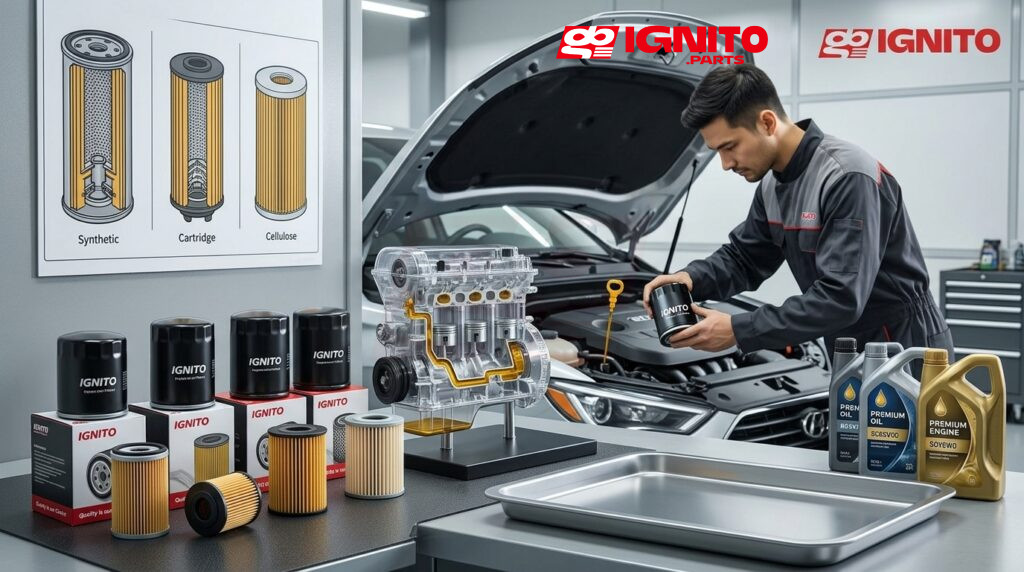
Different Types of Engine Oil Filters
Spin-On Oil Filters
A spin-on filter is a sealed metal canister that holds the media, base plate and gasket. You unscrew the whole unit and fit a new one. Installation is simple, and the anti-drainback valve is built into the unit.
Cartridge Oil Filters
A cartridge filter is just the filter element and its O-rings. The housing stays on the engine and is reused. Both designs can filter very well, since results depend on media and build quality. The catch is installation: forgetting the new O-ring or seating the cartridge badly can cause failure.
How to Choose the Right Engine Oil Filter for Your Car
Start with your car’s details, then work down to the filter’s construction.
Vehicle make, model, year and engine variant. A Perodua Myvi, a Toyota Vios and a Honda City do not share one engine. Even a single model can change engines between years. Check engine size and variant, not just the badge.
Manufacturer specifications and OEM part number. Your owner’s manual or the old filter shows the OEM oil filter part number. Use it for oil filter cross-reference when comparing brands. Oil filters are not universal, so follow the specifications in your manual.
Size, thread and gasket. Diameter, height, thread and sealing gasket must match the mounting point. A poor seal means leaks, and leaks mean oil loss.
Filtration media and efficiency. Cellulose suits standard intervals. Synthetic blend and full synthetic media offer higher efficiency and capacity, which suits synthetic oil and longer intervals. Efficiency is usually tested at 20 microns, and a lower micron rating means finer particles are caught. Media quality matters more than pleat count.
Bypass valve and anti-drainback valve. The bypass valve opens when the media clogs or cold oil is too thick, so the engine is never starved. The anti-drainback valve keeps oil in the filter when the engine is off, giving faster lubrication at start-up. Silicone valves handle heat better than nitrile.
Driving conditions and service intervals. Heat, short trips and stop-and-go traffic are hard on oil. Follow the interval in your manual and replace the filter at every oil change.
Physical fit alone does not guarantee compatibility. Two filters can thread on identically yet differ in valve calibration, media and flow capacity.
Genuine vs Aftermarket Engine Oil Filters
Genuine filters are built to the carmaker’s specification for your engine, so matching is straightforward. Aftermarket filters from established filter makers can meet comparable standards, often at a lower price.
Neither group is automatically better. Quality varies between aftermarket brands, and a genuine part is not a guarantee if it is wrong for your variant. Judge by specification, brand reputation and a verified match, not by price or label alone.
Common Mistakes to Avoid When Buying an Oil Filter
Choosing by price alone. Engine oil filter price varies widely. A very cheap unit may skimp on media or valves, and the savings disappear if it fails.
Ignoring vehicle specifications. Buying “the usual one” after changing cars, or assuming a similar-looking filter will do, is how wrong parts get fitted.
Choosing by appearance. Colour, branding and canister shape say little about what is inside.
Overlooking replacement requirements. Cartridge filters need new O-rings. Spin-on gaskets should be lightly oiled and seated properly.
Where to Buy the Right Engine Oil Filter in Malaysia
Ignito Parts is an online auto parts store in Malaysia. If you want to buy an engine oil filter online, start with the oil filter category. You can also add engine oil and air filters for a full service.
Use the shop’s vehicle filters (brand, make and year) to narrow the list. Then compare the part number against your manual or old filter before checking out. For general tips on buying parts online, read how to choose a reliable spare parts shop. You can also Follow Ignito Parts on Facebook for updates.
Frequently Asked Questions
How often should I change my oil filter? The usual rule is at every oil change. Your owner’s manual gives the exact interval for your engine.
Do I need a different filter for synthetic oil? Filters designed for synthetic oil use synthetic media, which copes better with longer intervals and the flow of synthetic oil. Check what your manual recommends.
Where do I find my OEM part number? Look in the owner’s manual or on the old filter.