
ATF Gear Oil vs Auto Gear Oil: What Is the Difference?
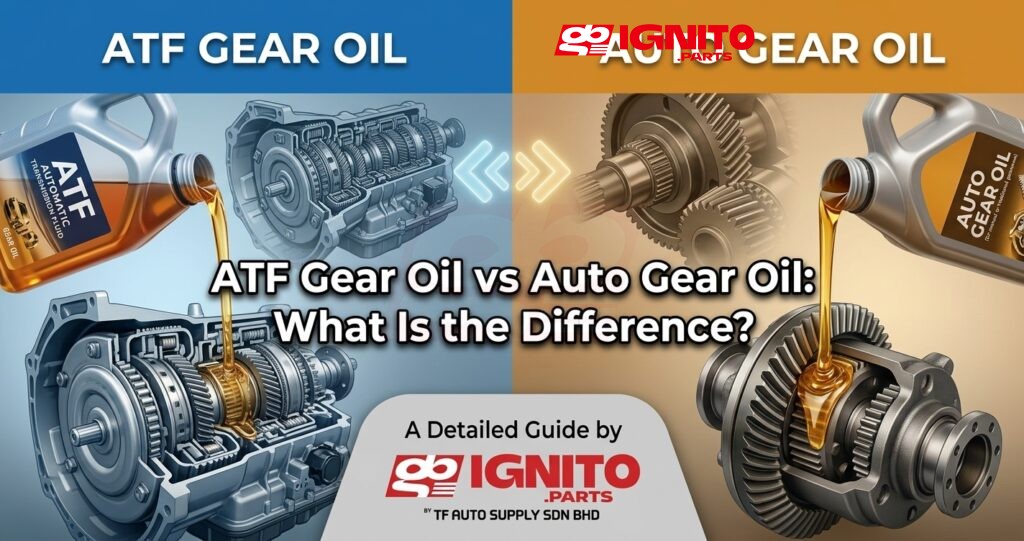
ATF Gear Oil vs Auto Gear Oil:
Many drivers ask a shop for “gear oil.” Then the seller asks, “Is it for a manual or an auto car?” That question confuses a lot of people. The two oils look alike in the bottle. However, they do very different jobs. The wrong one can cause rough shifting and fast wear. This guide explains the difference in simple words.
ATF vs Gear Oil: The Quick Answer
People often say “ATF gear oil,” but ATF is a different product. ATF is a thin fluid made for automatic gearboxes. The other oil is thick and made for manual gearboxes and differentials. Here is a side-by-side view.
| ATF | Gear oil | |
|---|---|---|
| Thickness | Thin, flows easily | Thick, clings to gears |
| Main job | Lubricates, cools, and helps the gearbox shift | Protects gears under heavy pressure |
| Common use | Automatic gearboxes, some power steering systems | Manual gearboxes, differentials, 4WD parts |
| Label to look for | The carmaker’s ATF spec | SAE 75W-90 and GL-4 or GL-5 |
What Is ATF and How Does It Work?
ATF means automatic transmission fluid. An automatic gearbox uses fluid pressure to change gears. So ATF does more than lubricate. It also carries heat away and helps the clutches grip at the right time. For this reason, it contains special friction additives. Makers often add a red dye, so new ATF usually looks red.
Each carmaker sets its own ATF rules. Therefore, always match the type in your owner’s manual. Also remember that a CVT gearbox needs CVT fluid. Regular ATF does not suit it.
You can see both fluids in our CVT and ATF fluid range.
Why Is Gear Oil So Thick?
In a manual gearbox or differential, metal gears press hard against each other. A thick oil film keeps the teeth from touching. Gear oil also has extreme pressure (EP) additives. These stop scoring and pitting on the gear surface. Common grades are 75W-90 and 80W-90.
GL-4 vs GL-5
Check the API rating on the label too. GL-5 has more EP additive than GL-4. However, some older manual gearboxes have soft metal parts called synchros. Strong additives can harm them. In those cars, GL-4 is the safer pick. Check your manual before you buy.
What Does Auto Gear Oil Mean?
“Auto gear oil” is a shop term, not an official grade. Most people use it to mean the oil for an automatic car. Depending on your gearbox, that could be one of three fluids:
- Regular automatic gearbox: ATF
- CVT gearbox: CVT fluid
- Dual-clutch gearbox: DCT fluid
So the safest way to shop is simple. Ask for the exact spec in your manual instead.
What Happens If You Use the Wrong Oil?
The wrong oil can hurt your gearbox quickly. For example:
- ATF in a manual gearbox that needs thick oil: ATF is too thin here. Gears wear faster, run hotter, and often whine.
- Thick oil in an automatic gearbox: The fluid cannot flow well. As a result, shifts feel harsh and clutches can slip or overheat.
- The exception: Some manual gearboxes call for ATF. Your manual is the only reliable guide.
Besides that, avoid mixing different oil types in one gearbox.
How to Choose the Best Gear Oil for Your Car
There is no single best gear oil for every car. The best choice is the one your manual asks for. Follow these steps:
- First, find the viscosity grade and API rating in your owner’s manual. For an automatic car, find the ATF or CVT spec.
- Next, match the oil to your gearbox type: manual, automatic, CVT, or dual-clutch.
- Then, think about how you drive. Towing, hot weather, and stop-and-go traffic are hard on oil. Synthetic oils handle heat better.
- Finally, buy from a seller that shows the spec clearly. At Ignito Parts, you can filter by brand, make, and year. Then you can check the gear oil options for your car. New to online shopping? Read our checklist for buying auto parts online in Malaysia.
How Long Does Gear Oil Last?
Gear oil change frequency depends on your car and your driving. Use these numbers as a general guide:
- Manual gearbox and differential oil: often every 40,000 to 80,000 km. Some makers allow up to 100,000 km.
- ATF: many makers suggest 40,000 to 80,000 km. Some call it “lifetime” fluid. Even so, heat and heavy traffic still wear it out, so many mechanics advise an earlier change.
Always check your manual first. Also watch for these warning signs:
- Whining or grinding noises
- Hard or late gear shifts
- A burnt smell
- Dark, gritty, or metallic-looking oil
- Oil leaks under the car
How to Fill the Oil Without a Mess
The fill hole often sits in a tight spot. In addition, the oil is thick and slow to pour. A gear oil dispenser, which is a hand pump with a hose, solves both problems. It pushes the oil in with less spill.
For a manual gearbox or differential, the steps are simple:
- Park on level ground and support the car with jack stands.
- Open the fill plug first. This proves you can refill the unit.
- Open the drain plug and let the old oil flow into a pan.
- Fit the drain plug back with a new washer.
- Pump in new oil until it reaches the fill hole.
- Refit the fill plug and check for leaks.
However, automatic gearboxes often need a set oil temperature to check the level. So let a workshop handle those. If you feel unsure about any job, visit a workshop instead.
FAQs
Is ATF the same as CVT fluid?
No. CVT fluid has a different formula for belts or chains. ATF in a CVT can cause slipping and damage.
Do automatic cars use thick oil anywhere?
Yes. Rear-wheel-drive and 4WD automatic cars still have a differential. It uses thick oil like 75W-90, not ATF.
Can I mix two different oils?
Avoid it. Topping up with the same grade and spec is fine. If you are not sure what is inside, do a full change.
How long can I keep an unopened bottle?
Usually about three to five years. Store it in a cool, dry place with the cap closed.
Conclusion
ATF is thin and works inside automatic gearboxes. The thick oil protects manual gearboxes and differentials. “Auto gear oil” is only a shop term, so always ask for the exact spec. Your owner’s manual gives the right answer every time.
Still not sure which oil your car needs? The team at Ignito Parts is happy to help. Contact us with your car model and year. You can also message us on Facebook for friendly advice.